

Cameron McKinney, Artistic Director, Kizuna Dance: U.S.-Japan Creative Artist Fellow 2019-2020
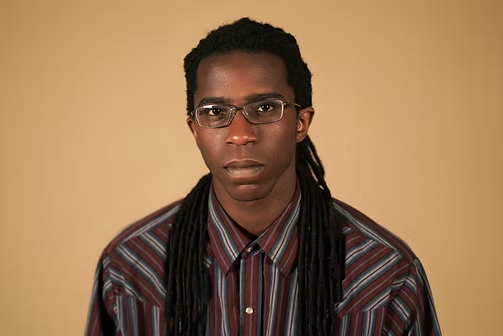
https://www.kizunadance.com/artisticdirector
For fifty years, JUSFC has promoted cultural exchange, artistic collaboration, and strategic dialogue to strengthen U.S.–Japan ties, recognizing that cultural literacy and mutual understanding are vital to diplomacy, economic cooperation, and security. Since 1978, JUSFC has partnered with the National Endowment for the Arts, Japan’s Agency for Cultural Affairs, and the International House of Japan to organize the U.S.-Japan Creative Artists Fellowship Program. The program offers residencies in Japan to American artists. In 2020, inspired by the 2020 Olympic Games, JUSFC selected American and Japanese artists partner together to collaborate on cultural projects and create new works.
This article features Cameron McKinney, a New York-based choreographer, dancer, and educator who participated in 2019-2020 U.S.-Japan Creative Artists Fellowship Program. Cameron McKinney is the founder and artistic director of Kizuna Dance presenting and teaching dance across the United States and abroad. He is advancing contemporary dance while cultivating a deeper understanding of Japanese culture and Japanese language.
Mr. McKinney, as a contemporary dancer who founded your own company and has been active in many areas, could you begin by sharing how you first encountered Japanese culture?
I first heard Japanese music being played as the theme song for a video game, and I became obsessed. Growing up in Memphis, there wasn’t much to do so learning Japanese became something to pass the time. I went to the library and picked up basic hiragana books.
Your mother must have been proud of you for learning a foreign language on your own.
She mentioned my interest to one of her friends, and they told her about a four-week immersion summer camp, called Mori no Ike, Japanese language village. I went to that camp and became completely obsessed with Japanese. After that, I enrolled at White Station High School in Memphis because it was the only school that offered Japanese class at the time. My hobby became a passion and then the guiding force in my life.

Japanese music was the starting point of McKinney’s journey into studying the Japanese language and culture.
How did you encounter dance?
I feel as if the story of my life is stumbling into things. As a high school student, I watched a lot of dance movies such as You Got Served, Center Sage and Step Up series. When I went to Middlebury College, I set a goal to try something new. Middlebury had a hip-hop troupe on campus, so I joined and stumbled into that world. One of the faculty members for the dance department once choreographed a piece for us —it was very simple—but I got hooked. I loved performing, especially the physicality of it.
And dance has now become your profession.
When I graduated college, I wanted to keep doing the things I loved most— studying Japanese and choreographing. Starting my dance company was a way to make that possible. Now, as a working professional, I have the pleasure of being surrounded by the people, environments, and experiences I enjoy most.
Has the company you founded, or your dance, been influenced by Japanese culture?
Yes. The company stemmed from my college thesis, which explored the intersections of Butoh and street dance forms. In my company I take different aspects of the Japanese culture and my experiences within it and juxtapose them against parts of the contemporary American culture or contemporary African American culture.

McKinney’s dance career began when he was a student at Middlebury College. His contemporary dances are often inspired by (aspects of) Japanese culture.
You created a dance style known as Nagare Technique and offered lessons in it. Was this technique also inspired by your experiences in Japan?
Yes, absolutely. I developed the Nagare Technique out of my thesis work, where I explored ways to physically connect Butoh and hip-hop. In 2013, I went to Japan and trained with Butoh teachers, which shaped the foundation of this approach. The technique brings together Butoh, capoeira, street dance, hip-hop, and contemporary floorwork —all styles with histories of rebellion, reclaiming identity, and building community. I described this idea as the ‘physicalization of rebellion,’ since each style emerged as a response to social or cultural pressures. While my company does not perform Butoh itself, I incorporate its philosophy— traditional meditation isn’t part of the practice, but the exhaustion the practice creates in the body is what I call “meditative exhaustion”
As you built your career in the field of dance, I am curious how you came to encounter JUSFC.
I participated in the fellowship in summer of 2019 only, but I was awarded it in 2018. I found the post about the JUSFC Creative Artists Fellowship application and learned about the opportunity to collaborate with a Japanese artist and showcase US-Japan cooperation alongside the 2020 Olympic Games. I thought, ‘This is the perfect culmination of everything I’ve worked toward—combining my life as an artist with my connection to Japan.’”
Do you feel you were able to achieve what you hoped for during your time in Japan through the JUSFC program?
The greatest challenge in continuing the work I envision for my company is simply having enough time in Japan. It’s expensive to travel, create work, and spend the time needed to build the kind of community I have in New York—but also in Japan. I haven’t fully had that opportunity yet.

In the JUSFC program, he engaged in exchanges with Mr. Shimazaki and his team. The JUSFC program aims to strengthen the ties between Japan and the United States, as well as to enhance America’s cultural competency.
That said, my JUSFC experience was the best step toward cultivating that experience. I developed a long-term relationship with Shimazaki-sensei, a Kobe-based choreographer who was my artistic partner during the U.S.-Japan Creative Artists Fellowship Program and collaborated with his dancers. That experience was the perfect culmination of everything I’ve been working toward for the past decade—making the dance I want to make, collaborating with a Japanese artist in Japanese, and seeing the work come to life after months of back-and-forth with Shimazaki-sensei’s team.
I think the experience proved to me that I am on the right path, as an artist, and that all the work that I had done since I was thirteen years old had prepared me to work with Shimazaki-sensei and his team. The JUSFC Creative Artist Fellowship was a super pivotal shift in my career.
How wonderful that the Creative Artist Fellowship had such an impact on your career. So, what’s next— what are your aspirations for the future?
My immediate focus is on our new work BREAD & CIRCUS, premiering Nov 20-23, but looking further ahead, I want my company to serve as a medium between Japanese and American artists. My dream is for it to eventually become a representative on the world stage, showing what contemporary American dance culture can be. Dance USA sends American artists abroad, and I want my company to play a similar role—primarily between Japan and the United States but also extending to other parts of the world. In the long term, I want Kizuna Dance to embody cultural exchange, representing American dance while staying open to learning from other worldviews and cultures.

McKinney envisions his company, Kizuna Dance as a cultural bridge—connecting Japanese and American artists and representing contemporary American dance on the global stage.