

JUSFC 50th Anniversary Interview Series: Spiegel Aihara Workshop
 For fifty years, JUSFC has promoted cultural exchange, artistic collaboration, and strategic dialogue to strengthen U.S.–Japan ties, recognizing that cultural literacy and mutual understanding are vital to diplomacy, economic cooperation, and security. Since 1978, JUSFC has partnered with the National Endowment for the Arts, Japan’s Agency for Cultural Affairs, and the International House of Japan to organize the U.S.-Japan Creative Artists Fellowship Program. The program offers residencies in Japan to American artists. In 2024, five teams of artists were selected to showcase their work at Expo 2025 in Osaka Japan.
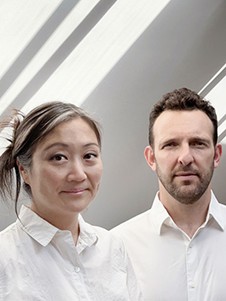
This article features a team of two accomplished California architects and educators Dan Spiegel and Megumi Aihara, founders of Speigel Aihara Workshop (SAW). Their showcased work titled: “Looking, After the Fires” is a watchtower structure which represents the responses to both fire and wildfires between Japan and America, providing a cross-cultural insight that examines fire as a symbol of renewal and regeneration.
I would be grateful if I could know the motivation as to why you became architects and designers.
M. Aihara: I approached architecture and landscape architecture from an art background, so I studied fine arts like sculpture, painting, and even glassblowing in college. I saw it as a way to bring the creative process into a built environment, integrating nature with architecture. All my experiences such as growing up in Hawaii and experiencing different natural environments were also an inspiration to me as well.
D. Spiegel: I studied public policy originally. After a few internships, I became interested in the ways in which the built environment has policy-like impacts on people’s lives. I eventually became interested in how designing the public-built environment can influence how communities develop and connections form, almost at a policy level. After studying public policy, I worked in an architecture office, then went to graduate school in architecture to put these ideas to the test. I became fascinated by how design can impact lives beyond pure policy outcomes, and I still firmly believe there’s a deep connection between design and policy.
You two met during your participation in the master’s program at Harvard. Could you tell us about your career journey after graduating?
D. Spiegel: I graduated in 2008, and that was when there was a full financial meltdown taking place, typically focused on the built environment. It was a subprime housing crisis. Megumi had a job that she’d been working at for several years with an amazing landscape architecture firm, so we just decided to kind of hang tight in Boston for a while. We just took on one thing at a time and one thing led to another, eventually we got the first major project opportunity in California. As I grew up here and it was much closer to Megumi’s family, we decided to move to California in.
M. Aihara: It’s definitely not the way we planned. We didn’t imagine what our office would be like in the future, but as Dan was starting business, I finally joined him full-time as well.
The theme of your work in the Osaka expo was a Fire Watch Tower piece “Looking, After the Fires.” and you also create the work about the landscapes after the fire. What inspired you to engage in projects related to fire?
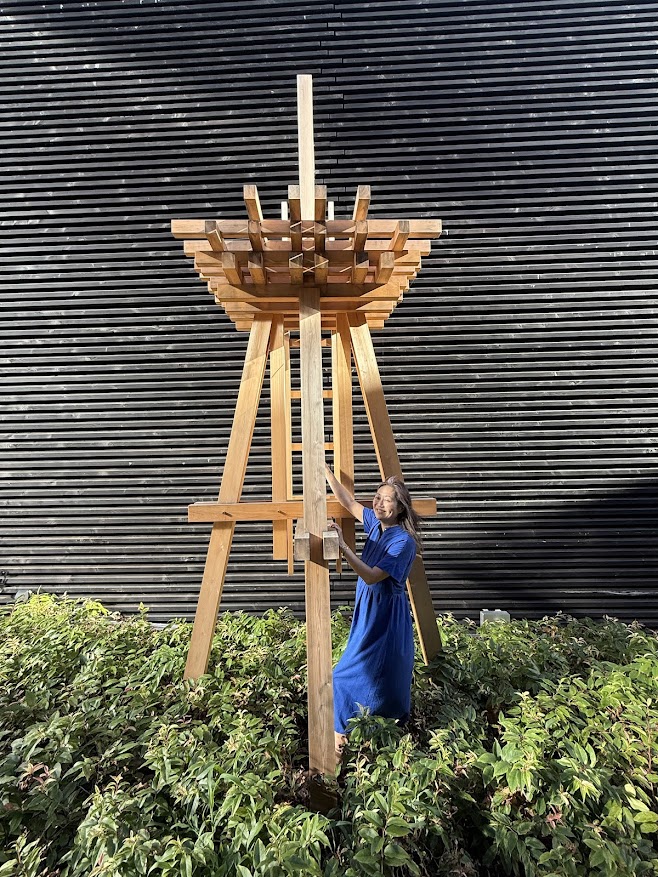
Looking, After the Fires: Spiegel Aihara Workshop & T. Teshima Architect & Associates’ watchtower on display with Aihara at EXPO 2025, Osaka, Japan.
M. Aihara: As you might know in California we’ve had lots of terrible wildfires recently, most recently in Los Angeles, but also in Northern California for many years as well. We wanted to have a chance to understand the topic from not only our perspective in California, but different ways that people around the world think about fire culturally. We found that in Japan it was very different, so we were interested in that as it gave us a chance to look comparatively at the history of fire suppression and firefighting between Japan and the United States, including the landscape differences that shape the problem.
D. Spiegel: It’s one of these things that we realize we share, in many ways, across cultures, because we have similar climate profiles. So, when we were also in Italy for instance, that’s also a Mediterranean climate which is like California, but they have much longer recorded histories with different cultural and historical responses to Great Fires.
It seemed like the response after the fire was always the same, and we wondered if there’s a better way. California’s wildfire history is embedded in cultural understandings: Native American tribes used controlled burns, but later policies suppressed all fire for nearly 100 years, creating an adversarial relationship and dangerous overgrowth.
We wanted to look at times when fire was understood as both destructive and regenerative.
M. Aihara: A necessary part of ecosystems and culture.
D. Spiegel: We asked: if fires will happen, how might we approach the built environment differently?
M. Aihara: We studied abandoned fire watchtowers—beautiful structures no longer used—. It’s not good to suppress all the forest fires. It’s good to let you know natural lightning fires happen.
D. Spiegel: If not to look out to prevent fires, why doesn’t anybody look at what happens after the fire? And so that became the premise of this piece. Having a vantage point, using the watchtower as something instead of which just to look out in a preventative manner, a defensive posture to have a place to revisit and watch things regrow, to watch the regeneration of the next thing as well.
What was the motivation for you to apply U.S.-Japan Creative Artists Program and how has the JUSFC’s support helped you advance your work?
M. Aihara: It allowed us to take time to do the research. Because we’re kind of running a business with day-to-day requirements, it’s hard to make time for these research projects that will help us and influence our design process.
D. Spiegel: In our usual work, we’re often moving towards solutions all this time, and this sort of program allowed us to pose new questions and just kind of follow those wherever they ended up taking us. We were aware of these sorts of Japanese tradition and processes in architecture and design, but it is very hard to research that through the internet or through books. Some of it is a language barrier, some of it is access or knowledge of what publications are available, and a lot of it is that you just must go out there in the community and speak with people and see things for yourself.
We had also had conversations with colleagues and friends of ours who had done this program as well, they said it was a life-changing amount of freedom that you had to just show up in a place and have an immersive experience. Having conversations without knowing what the outcome will be—and just follow the work and interactions wherever they might lead. We believe that you must spend time in these places to understand them.
You also collaborated with Architect Tamotsu Teshima during your stay in Japan, how was the collaboration? Your work was exhibited at the Osaka Expo.
M. Aihara: It was very interesting. we’ve had friends who’ve interned at other architecture offices in Japan, and I had heard the cultures very different. So, it was nice to see ourselves when we got to visit and see how his office runs.
D. Spiegel: The collaboration was great. I think to a degree the Expo project would have been impossible without it. We needed the knowledge of local conventions of drawings, fabrication processes, and connections to contractors who could execute the work and be on-site. From a practical perspective, it was necessary, but I think just as a sort of design and intellectual process, it also was very fascinating and meaningful to work with him and his team. Even though the differences between how architecture is practiced in Japan and the U.S. might seem small from the outside, when you’re deeply immersed in it, those differences feel profound. We learned so much from working with them while deepening a friendship and we hope that it leads to more collaborations in the future.
So, did you get some takeaways from this trip…would you be able to leverage any of your experience into the future work or architecture?
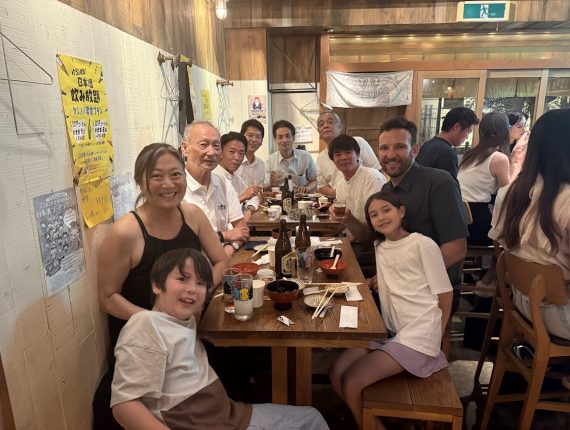
Spiegel and Aihara enjoying a meal with Tamotsu Teshima and friends during their stay in Japan.
D. Spiegel: You never know what’s going to lead to what. This has happened to us more than a few times over the last year, you bump into somebody and have a casual conversation, and they tell you something you should check out. Then you go check out that thing, and you meet another person and check out something else, then before you know it, you’ve had a network of experiences that you never would have even thought of looking for. It’s more of knowing what it is that one should be pursuing or looking for and having the opportunity to turn one experience into the next. You can never anticipate the connections and experiences you might have or what knowledge might come from them.
How has your time in Japan and your engagement with Japanese culture influenced your personal or professional journey?
M. Aihara: Personally, it’s also been a reconnection to roots and family, especially since I hadn’t spent much time in Japan as an adult. These experiences are influencing how we as a community consider evolving family structures in the present and are inspiring projects to imagine more communal, flexible, and culturally resonant ways of living together.
D. Spiegel: Professionally, as stated previously we’ve built relationships we hope will grow into long-term partnerships, and we’ve further developed a mindset in our work that values care, maintenance, and the lived experience. That perspective has carried into our teaching in our design studio and at UC Berkeley as well, where Japanese precedents—from the kura storehouses to more fluid spatial conventions—are helping us rethink how homes and buildings can be organized and utilized beyond traditionally rigid western real-estate categories.
Tell us about your future vision. What ways might you continue to support the Japan-U.S. relationship or people-to-people connections in the future?
D. Spiegel & M. Aihara: There are a lot of things we’re interested in, from furniture to master planning so our future vision is rather diverse. To us, creative work is now about asking what it means to work or exist productively when so much work can be done through Artificial intelligence and technology: how we feel, experience, and reconnect our physical, spiritual, and psychological selves to the world. That’s why we were so drawn to the Japanese fire festivals, a setting where people come together around something seen as dangerous in space yet optimistic or a symbol of rejuvenation in another. Continuing to explore and share these different kinds of cultural insights and bringing them into our work in architecture is how we hope to support these people-to-people connections and relationships moving forward.