

The United States Japan Exchange & Teaching Program Alumni Association
 For five decades, JUSFC has made vital contributions to promoting U.S. national interests, peace, prosperity, and security in the Indo-Pacific by supporting the U.S.-Japan Alliance. In this article, we feature the United States Japan Exchange & Teaching Program Alumni Association (USJETAA), meaningfully contributing to sustaining knowledge infrastructure of Japan across U.S.
“JUSFC’s institutional support is a foundation in helping USJETAA evolve from a new and small organization into a more sustainable national organization with infrastructure,” noted Jessyca Livingston, Executive Director, USJETAA.
Founded in 2015 as a non-profit organization, USJETAA supports the alumni community of the Japan Exchange and Teaching (JET) Program *1. The U.S.-Japan Conference on Cultural and Educational Interchange (CULCON) recognized the essential role of JET alumni in advancing the U.S.-Japan partnership. Based on its recommendation, USJETAA was envisioned as a national organization to connect more than 40,000 JET alumni and the 19 JET Alumni Associations across the United States.
“Our mission is to strengthen the U.S.-Japan relationship through JET alumni engagement and grassroots diplomacy,” Ms. Livingston said.
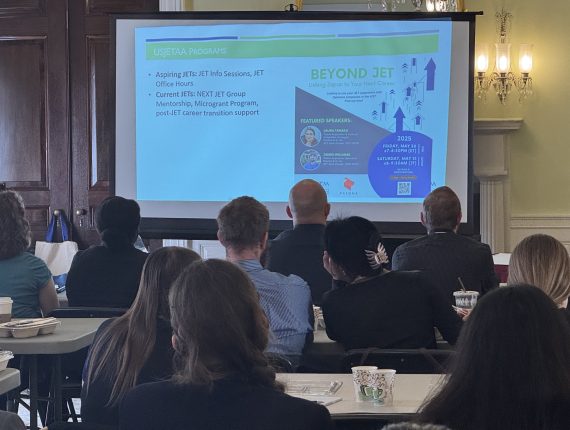
Jessyca Livingston (right) delivering a talk at the JETAA National Conference. JET alumni are a vital resource in sustaining Japanese knowledge infrastructure and advancing the U.S.-Japan partnership.
Connecting JETs’ experience with their future careers
The challenge is clear: how can the experiences of JET alumni be connected to their careers in ways that benefit the U.S.-Japan partnership? When participants complete the JET Program in Japan, they face the practical challenge of securing meaningful employment.
“Our focus is to help JET alumni find jobs that keep them connected to Japan, because that strengthens the U.S.-Japan relationship,” explained Ms. Livingston.
For many alumni, however, navigating Japanese companies or finding ways to connect their Japan experience to their careers can be difficult. USJETAA provides crucial support, helping alumni leverage their skills and experiences for bilateral benefit. “From career coaching to industry-specific career panel discussions, we offer a wide range of resources so that JET alumni can discover how their experiences contribute to industries and companies,” noted Ms. Livingston.
When Japan Experience Creates New Paths
While many alumni pursue jobs directly tied to Japan, others enter industries that may seem unrelated. Yet even in these cases, their Japan experience often finds unexpected ways to flourish.
“One JET alum works in healthcare and initiated an exchange program between American and Japanese hospitals,” shared Ms. Livingston. What began as grassroots engagement evolved into a professional initiative with tangible economic and social impact for both countries.
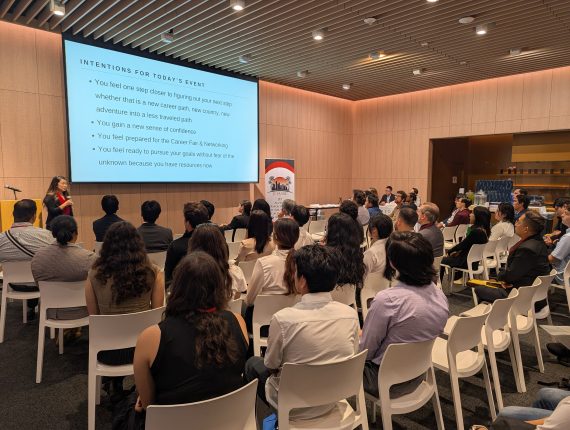
USJETAA-sponsored career seminars help JET alumni transform their Japan experiences into careers and contribute to strengthening the U.S.-Japan Alliance.
Supporting Chapters Across the United States
Comprehensive support for JET alumni is achieved through collaboration with 19 chapters across the United States. These chapters are run entirely by volunteers and often operate with limited resources. This is where the role of USJETAA becomes especially significant.
“We support [chapters] through funding for their activities. We’ve provided leadership training, and we also help educate chapter leaders on current U.S.-Japan political trends—topics that are top of mind,” explained Ms. Livingston.
Together, USJETAA and the chapters host close to 600 events each year, creating countless opportunities for alumni to engage, network, and continue contributing to the U.S.-Japan relationship.
JUSFC’s Support to Fortify the U.S.-Japan Partnership
JUSFC’s institutional grants have been instrumental in supporting the development of USJETAA’s services. “We’ve been able to expand our programming and build strategic partnerships that amplify the long-term impact of JET alumni thanks to the grants provided by JUSFC,” noted Ms. Livingston.
JUSFC’s grants have meaningfully contributed to alumni job hunting, sustained regional JET alumni communities, and strengthened grassroots support that elevates the U.S.-Japan partnership to a higher level. The impact of JUSFC’s funding extends beyond economic contributions, enabling USJETAA to deliver quality services and broaden its national reach.
“The endorsement and support from JUSFC opened many doors within both the U.S. and Japan policy communities, helping establish USJETAA as an integral part of the U.S.-Japan community. The grant allowed us to position JET alumni as valuable contributors to bilateral relations,” remarked Ms. Livingston. “I don’t think we would have been nearly as successful without JUSFC’s support.”

JET alumni gather online to deepen their knowledge and continue to nurture their ties with Japan.
What’s Next for USJETAA
According to Ms. Livingston, there is still much to do. Priorities include introducing a database to connect the 19 chapters across the United States, allowing them to efficiently share information, and expanding professional development programs that strengthen ties with Japan.
Ms. Livingston sees vast potential in the JET alumni community to contribute not only to the United States but also to global society. “There are many opportunities for the U.S. and Japan to collaborate on a variety of issues,” noted Ms. Livingston. “The JET Program has a legacy promoting collaboration between two nations—whether on global challenges such as climate change or security. USJETAA continues playing a role in connecting those dots, ensuring that JET alumni are part of the solutions to larger global issues.”
*1 JET program: Japan Exchange and Teaching Program is a Japanese government initiative that brings young professionals from abroad to work in local communities, mainly as language teachers or international relations coordinators. *