

Bashō’s road
throughout Tohoku
hope remains
In the 17 syllables of this haiku, which appeared in Japan’s Asahi daily newspaper, LA contributor Stephen DeGuire captured his feelings in the initial aftermath of the earthquake, tsunami and nuclear explosion that devastated Fukushima, Japan on March 11, 2011 – known commonly now, as 3-11. He was referring to the lands through which the 17th century haiku master Matsuo Bashō traveled on his pilgrimage from Edo (now Tokyo) to Fukushima referenced in his famous work “The Narrow Road to the Deep North.” Those lands now largely destroyed by the disasters.

The U.S.-Japan Creative Artists Team of Natsuka Endo, Hiroyuki Abe, Bruce Douglas, and Sue Mark
In 2020 Sue Mark and Bruce Douglas, founders of marksearch, will embark upon a journey following some of the historic markers along Bashō’s road, paying homage to his quintessential Japanese poetic form. They will do this by curating a collaborative haiku of words and phrases submitted by local residents they meet along their journey.
“Writing is hard for everyone. Even though haiku is short, it’s an art to write one,” Sue explains. “We are thinking of a less stressful way, so it becomes more of a game. We want people to feel welcome to contribute words – young, old, in English or in Japanese.”
Their project, “The Journey Itself Home,” “旅はすみか”, is one of five that will be funded through the U.S.-Japan Creative Artists Program of the Japan-U.S. Friendship Commission and National Endowment of the Arts. Based in Oakland, Calif., this pair of cultural researchers hope their project will help the international community remember and honor the survivors of the 2011 Fukushima disasters. They have teamed up with Tokyo-based multimedia artists Natsuka Endo and Hiroyuki Abe for their project after Sue and Hiroyuki met through a mutual friend. Once introduced, they discovered that they are both influenced by the same thinkers and artists, and had many other things in common.
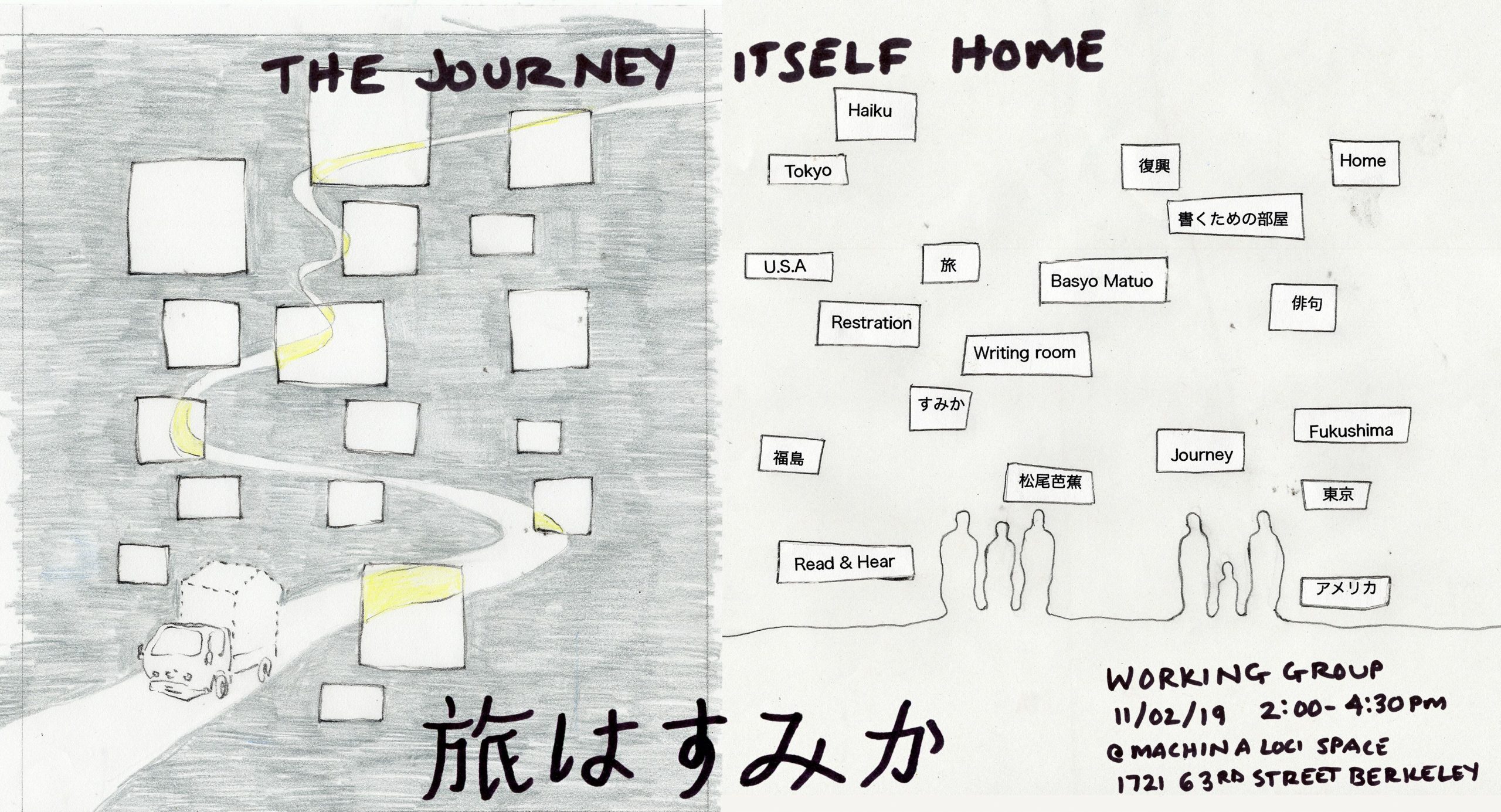
The Journey Itself Home” Concept
“This project poetically explores the depth of taking care of each other, which in the U.S. we don’t do as much or as well as the Japanese,” Sue tells us. “It is an incredibly rich experience as people in the world understand different ways of interacting. Our work involves learning historic preservation but also community building and neighborhood ties.” “We are excited about working on the project,” shares Natsuka, who with Hiroyuki and their young son visited Sue, Bruce and their son at their home in Oakland in October. “It’s impossible to do this by ourselves. It has been eight years since the earthquake, so it’s been lost in the past for the general public. Only people who live in the area still focus on it,” she adds.
For more than 20 years, marksearch has been designing interactive opportunities for communities to publicly share personal histories as a means of empowerment – and participated in another project supported by a JUSFC Creative Artists Fellowship in 2017. From neighbor-led walking discussions to sidewalk performances, commemorative plaques recognizing previous generations’ collective knowledge to collaborative murals, their global projects preserve neighborhood narratives.
Based in Tokyo, Hiroyuki and Natsuka’s works are based on artistic research about local history or people who lived there, making installations with drawings and videos to visualize their memories and personal experiences. “We cover every discipline among the four of us on this project – painting and drawing (Natsuka), audio-visual (Hiroyuki), engineering and design (Bruce), and writing, research and photography (Sue),” says Bruce.
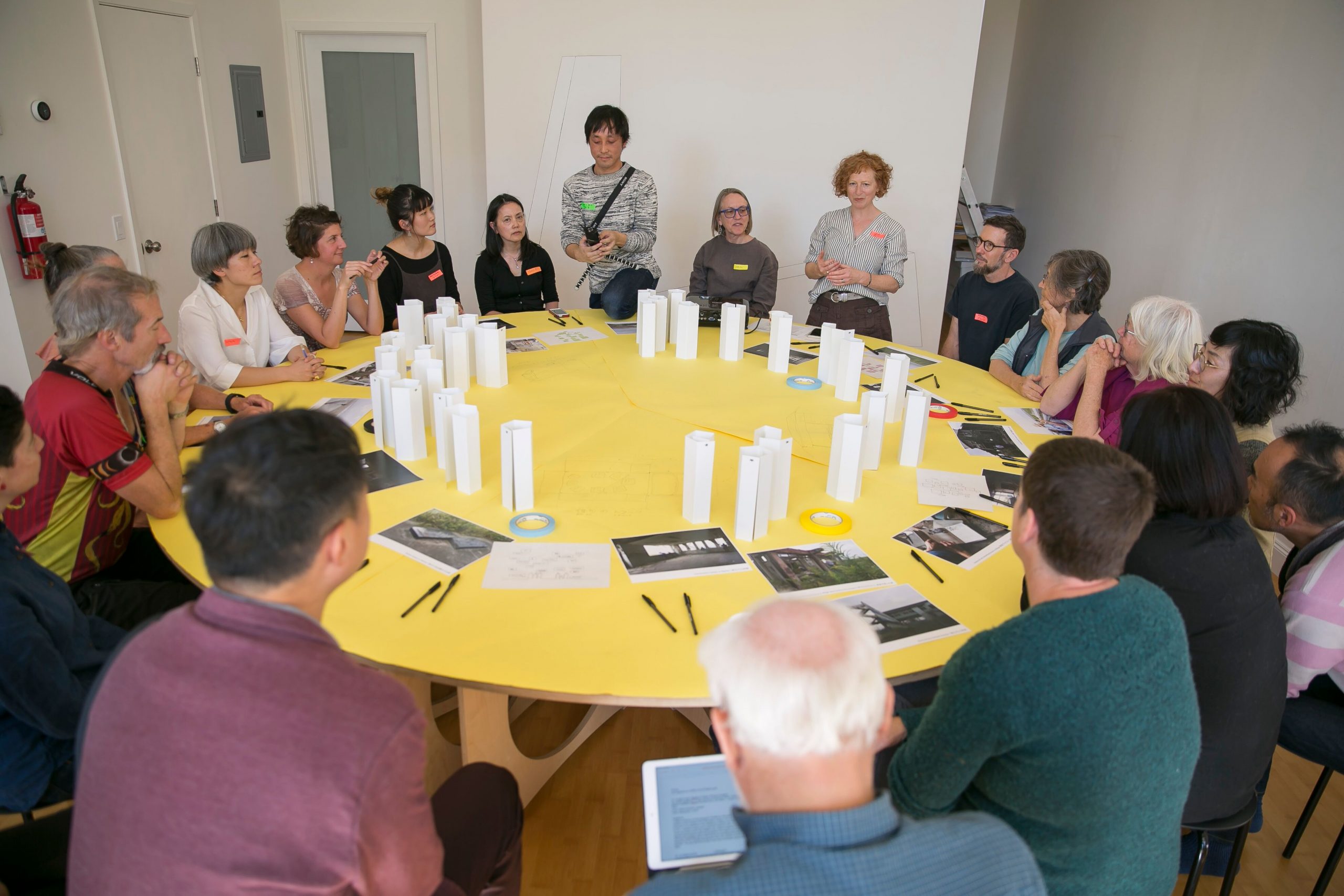
The community working group in Oakland, CA
Together in Oakland, the couples worked on preliminary design development and strategic planning. They also organized a workshop with local community activists, environmentalists, writers, teachers, artists, architects and designers to discuss the many questions the project raises. Sue and Bruce will begin their six-month residency in Japan in March 2020 and will work with Natuska and Hiroyuki to identify communities, schools and organizations interested in participating in the project. This U.S.-Japan artistic team will travel via a truck which they will construct as a nomadic writing room. The design will combine modern and traditional building techniques. The writing room will include visual and audio installations of the haiku they collect to form a communal poetic message of hope and resilience.
They expect their truck to be on exhibit in Tokyo during the Olympics, where they hope to engage with international athletes as a part of this project. Ultimately, this U.S.-Japan artistic pair would like for the Center for Remembering 311 in Sendai to become the permanent home for their finished exhibition.
“Collaboration is quite important for our project. It allows us a deeper experience,” notes Hiroyuki. “When we come to the U.S. and talk about 311, we can understand how this tragedy is viewed in the world through an ‘outside eye’ looking at Japan. We bring the ‘inside eyes’ to our U.S. partners. We are truly thankful to JUSFC for giving us this opportunity.”
To learn more about JUSFC’s Creative Artists Program and Grants, visit our website here.