

Krystelle Thomas, Graduate Student: 2023 JUSFC Summer Institute Alumni
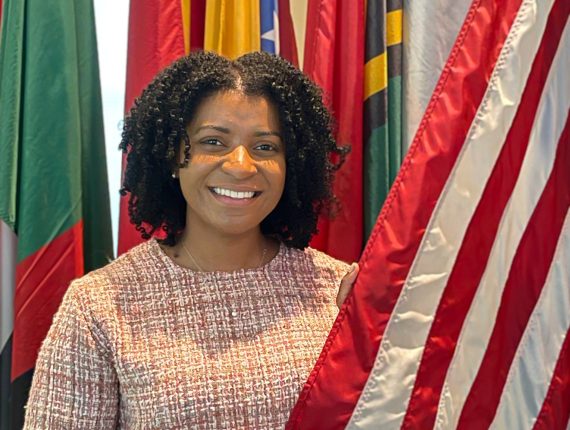 Over the past five decades, the Japan-U.S. Friendship Commission (JUSFC) has strategically invested in developing human capital. Through its grants, JUSFC has helped build critical knowledge infrastructure within U.S. institutions, preparing future generations to advance U.S. interests in the Indo-Pacific. Similarly, the JUSFC Summer Institute directly advanced U.S. national interests by training undergraduate students through intensive academic programming and immersion in Japan.
This article highlights Krystelle Thomas, a young American who participated in the JUSFC Summer Institute in 2023. She earned her bachelor’s degree in the U.S. and later went to Germany to pursue a master’s degree and gain professional experience.
Tell me about your first encounter with Japan.
It started with Japanese culture I was born in New York, but my family is from Guyana, and we moved back to South America for a while. When we returned to New York, one of the first things we did was go to a soccer and Matsuri festival in Brooklyn. That experience really stuck with me —seeing Japanese culture gave me a sense of nostalgia and acceptance, especially as I was connected to a new place.
How has your interest in Japan developed?
I first wanted to study Japanese in high school, but since my school didn’t offer it, I chose Chinese, thinking the kanji might help later. When I started at Swarthmore, that opened the door to Asian studies more broadly, and I became interested in East Asia from a comparative perspective. The real turning point came when I transferred to CUNY, where I had an amazing teacher, Dr. Michael Sharpe, who works closely with JUSFC. It was the first time I engaged with Japan academically, and it sparked my interest in looking at Japan through a comparative lens.
You had a great mentor. How did that experience shape the way you see Japan?
In a few ways. At first, if you’re focused on Studio Ghibli, you have this very idealized view of Japan. In Dr. Sharpe’s class, we spent a lot of time on Japan’s development, immigration, and minority groups—not the glamorized version you see on TV. Learning about people and their history was important to me. I also started thinking more realistically about the connections between Japan and my own culture. Plus, I focus a lot on climate policy, and Japan offers fascinating case studies, like hydrogen and green hydrogen. So, it sparked my academic interest.
Thanks to your faculty’s recommendation, you learned about JUSFC’s Summer Institute. Before attending, what was your vision for the future?
I definitely saw myself working locally. When I applied, I was interning at the New York State Assembly as part of my graduate program at CUNY, focusing on climate policy and state law. I imagined staying in New York, maybe getting a degree in public administration and working in that field. But I always had this vision of something more international. After the Summer Institute, I want to travel—I even started thinking seriously about becoming a diplomat. The experience made me want to learn more and become an expert before committing to that path. It also deepened my interest in East Asia and Japan, and I plan to take my time building that expertise
And you successfully got accepted into JUSFC’s Summer Institute. How was your experience during your stay in Japan?
I’ll happily say it wasn’t an idealized PR trip—it was a wide range of experiences across Japan, and that was amazing for me. As someone who has always wanted to be a diplomat, spending time in Japanese embassies and talking to people was incredible. We visited Toyota, where I asked questions about EVs and car batteries. We spoke with a journalist and met a group training women to enter politics. We also visited an all-women’s college, where students were very open about their experiences—I still keep in touch with some of them. I felt so fortunate to hear everything I wanted to hear. Honestly, I didn’t expect as much as I got, and that was wonderful.

The Summer Institute experience in Japan enhanced her cultural competency and made her more adventurous. JUSFC plays a vital role in cultivating human capital to advance U.S. interest.
How did the Summer Institute program change you?
I think it is definitely giving me cultural competence that I really pride myself on being able to communicate across cultures. What’s important, especially in conversations, is acknowledging differences first. For example, in some cultures, we ask questions first; in others, we make assumptions. We need to first acknowledge that we’re all coming from different pages, and we could share our expectations here. This will help in the negotiating table, and something I saw when I was at the U.S. Mission to the UN.
The experience also made me more adventurous. Before, I wouldn’t have traveled solo in Europe. On the last day of the Summer Institute session in D.C., right before we left for Japan, I got my acceptance letter from Hertie School in Germany.
Wait. You did? What incredible timing!
At first, I wasn’t sure if I’d go. But after Japan, I thought, ‘I can do this. I can do it other countries.’ I discovered I love the fish-out-of-water feeling and exploring new cultures. Now, I’ve been here in Germany for two years, taking intensive German classes. Honestly, the only reason I managed this is because of what I learned in Japan.
Professionally, having JUSFC’s Summer Institute as part of my background—and something I can speak about—has been incredibly valuable. It helped people see me as a capable diplomat, someone who can navigate hard situations. I learned how to conduct myself with cultural competence, and that made a real difference. When I was at Hertie, I got an amazing position at the U.S. Mission to the UN—honestly, my dream internship. I truly believe the Summer Institute helped open that door.
The program also gave me incredible connections, including my cohort, who are so like-minded. And JUSFC’s staff told us while we were there, ‘You’re part of our network now.’ If we ever need them, they’re here for us—and that’s so important
JUSFC’s program clearly supported your journey. Lastly, what are your future aspirations?

After completing her studies at Hertie, she continues her journey toward her future dreams. “I will give it all back as a diplomat,” mentions Krystelle.
My first trip abroad was years ago through a State Department program to Peru. Later, I went to China in high school—both thanks to grants. Then came Japan. After the Summer Institute, my vision of becoming a diplomat became clearer, but the trip also made me want to learn more and gain expertise before committing fully. I want to deepen my knowledge of East Asia and Japan. Right now, I’m passionate about climate policy and sustainability—how we can unite globally to address climate change. Starting in January, I’ll be working at a Berlin-based climate tech company on carbon projects. I hope this gives me practical insight into global momentum on climate solutions. Ultimately, I want to bring all these experiences back to serve as a U.S. diplomat.