

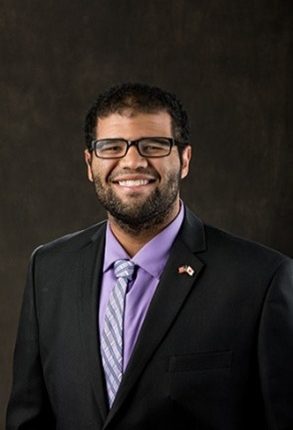
Deven Richardson, Director of Existing Business and Community Development for the Commonwealth of Kentucky, JUSFC/CULCON Fall Internship 2020
 Throughout the years, the Japan-U.S. Friendship Commission (JUSFC) has stood committed to advancing cross-cultural understanding between the United States and Japan through the promotion of pathways for professional engagement in U.S.-Japan Relations. Extending this mission to the next generation, the JUSFC/CULCON Internship Program has supported students and young professionals interested in deepening their interest of the U.S. Japan relationship with a paid internship opportunity to develop and improve hands-on skills. Through close mentorship, meaningful responsibilities, and introductions to Japan-related events across Washington, D.C., the program equips emerging professionals with the experience, confidence, and networks that support career paths connected to the U.S.–Japan partnership.
This article features Deven Richardson, a prior JUSFC intern who now serves as Director of Existing Business and Community Development within the Cabinet for Economic Development for the Commonwealth of Kentucky. Prior to his current position, Deven served as a Foreign Service Officer for the U.S. Department of State at the Tokyo Embassy for three years as a Consular and Economic Officer As a native of Kentucky with a demonstrated interest for supporting cross-cultural understanding, Deven is working to further the U.S. Japan Partnership through supporting the growth of Japanese trade and business within his state.
Firstly, I’d like to ask you about the interest you have with Japan…what first inspired you to learn about, experience, or connect with Japan?
When I was 7 or 8 years old, I was at a summer camp. I think this was the very first time I ever had any interaction with the Japanese culture. There was another kid there by the name of Koki, he was a Japanese student who moved from Tokyo to Bowling Green. I remember seeing him playing the Japanese version of Pokémon on his Game Boy. I naively asked how he was able to play it, because at the time I thought Pokémon was an American thing — it was in English, and I only knew Ash and the Pokémon names from the shows I watched. He explained that it was originally Japanese and used it as an opportunity to introduce me to that part of his culture. That moment sparked my curiosity, and we’ve stayed close friends ever since.
Which parts of Japan have you traveled to? How was your experience?
When I got to college, I decided to take some of that interest to study abroad. I received the Gilman Scholarship from the Department of State and studied at Kansai Gaidai University in Osaka. That was the very first time I’d been ever on a plane or ever even left the country, so it was a big jump, and I’m glad I did it too as that’s when I started learning the Japanese language. After I finished my semester there, I knew that my dream to serve as a diplomat in Japan. I later went on to participate in the Fullbright program to study at Waseda University in Tokyo before serving as a Foreign Service Officer at the U.S. Embassy in Tokyo for 2 and a half years. The US-Japan relationship to me was very important, because I think about how that bridge was built at the very beginning, just from a Pokémon game and now, I want to be on the forefront of doing that kind of work in the future.
I’d like to know more about your current career as it relates to your interests, what do you do now?
Currently in my role, I have a focus in the U.S.-Japan companies all throughout Kentucky and support the growth and development of new Japanese business entering the state. There are over 220 Japan-based companies here, through manufacturing, automotive, medical, and a lot of other industries. As part of that, I get to oversee and manage business expansion projects and meet with a lot of these companies to support the working relationships between them and the Kentucky. We also participate in events and support a lot of Japan related nonprofit organizations such as the Japan America Society of Kentucky. I even still get to travel to Japan every now and again which is something I always hoped to be able to do for work.
How was your internship in JUSFC/CULCON, how did the experience influence your personal and professional journey?
In 2020, I moved from Japan and to Georgetown after participating in the Fulbright Scholarship at Waseda University It was right during the height of COVID when I saw the listing on the JUSFC website, and I was very interested as it was all about what I was doing during my undergraduate studies at the University of Western Kentucky and when I studied abroad. The internship was a wonderful and life-changing experience as I got to not only continue my experience by building my technical skills while supporting JUSFC and CULCON, but also I had the opportunity to develop numerous of contacts across U.S.-Japan related organizations and companies that would assist my future as an at the U.S. Embassy in Tokyo and eventually with the Kentucky Government.. Since I can not only speak the language but have background working with JUSFC and CULCON, I have been given the opportunity to do some very inspiring public diplomacy work.
Tell us about your future vision. In what ways will you support Japan-U.S. relationship in the future? 
This is what I want my specialty to be. I left the diplomatic position to this because I have a love for my home state, and I’m helping to build a bridge between the Japanese and Kentucky economies. I’m getting to serve on the front lines the U.S.-Japan Partnership because of that, and that’s something I really love. Because I’m still relatively young, I’ve thought about going back and doing a PhD program to focus on international security and Japanese politics. To be quite honest, I don’t know where that road leads, but I do know throughout my whole career and all my experience so far, it’s still pushing in that trajectory to be a sort of champion for the U.S.-Japan relationship, whether it be politically, globally, or politically, economically, or culturally.