

**JUSFC U.S.-Japan Creative Artist Grantees are available for remote interviews and demonstrations. B-roll is also available.**
More Information:
Karen Bate
kbate@kbconcepts.com 703.402.2672
The 2020 Olympics and Paralympics may be postponed until next year due to the ongoing global pandemic, but five teams of creative artists from the United States and Japan (NichiBei Artists) continue working together on innovative projects that reflect this Summer Games themes; unity, collaboration and the long-time friendship between the U.S. and Japan. The completed projects – supported by a grant from the Japan-U.S. Friendship Commission (JUSFC) and the National Endowment for the Arts (Arts Endowment) – were to be showcased in Tokyo at the same time as the Olympic and Paralympic Games in the coming weeks.
“Despite the ongoing challenges of Covid-19, this program continues to be a priority for the Commission and the NEA as we promote the value of cultural and artistic exchange between the U.S. and Japan, and the power of the arts to unite us and foster resilience,” said Paige Cottingham-Streater, Executive Director of JUSFC in Washington, D.C.
The five teams of artists each received a $25,000 fellowship award and up to $2,500 for travel. The projects range across artistic disciplines, from music and dance to creative writing and visual arts, and explore subjects like martial arts (with karate being an Olympic sport for the first time at these Games), the upcoming 10th anniversary of the 2011 Fukushima disaster (known is Japan as 3-11), and sustainability through the lens of food and agriculture.
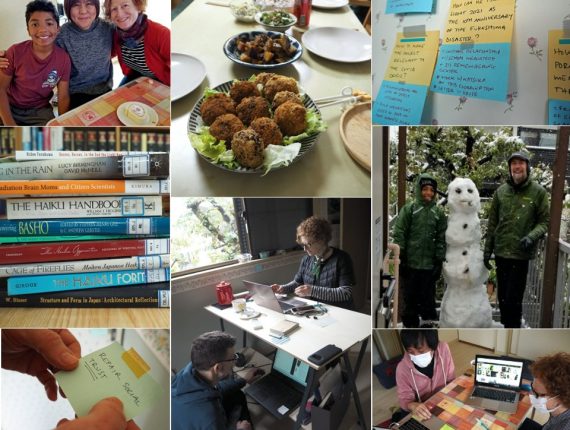
When Conversation Artists Sue Mark and Bruce Douglas of marksearch and their 11-year-old son left their Oakland, CA home for Tokyo in mid-March, they wondered if they were making the right choice. For months they had been planning to live in Tokyo, stay through the Summer Olympics and Paralympics, and complete their project “Journey Itself Home,” a U.S.-Japan collaborative poetic exploration honoring survivors of the 2011 Fukushima disaster.
“While having the Olympics cancelled, being under quarantine in a 400 square-foot apartment far from our loved ones, and postponing our project for a year could be setbacks, we actually feel the meaning of our work is really amplified now,” Sue notes. “This extra time allows us to research more deeply into Fukushima survivor narratives and how we can tie our work in with the region’s 10-year disaster recognition. The Japanese concept of ‘shou ga nai’ (しょうがない)—which translates loosely to being at peace with that which is out of your control—is a theme that is very relevant, and one that we are trying to embrace,” Sue adds. Since it is no longer possible to hold workshops with schools and community groups. Sue, Bruce, and their Japanese partners, multimedia artists Hiroyuki Abe and Natsuka Endo, have revised their ideas about a traveling arts studio. “Instead of a mobile meeting space, we will now incorporate elements such as kinetic sculptures and audio to engage viewers, while still allowing for social distancing,” Bruce explains. “We plan to drive it slowly through the streets of Tokyo next summer, after which our work will be exhibited at the Setagaya Art Museum in Tokyo.”

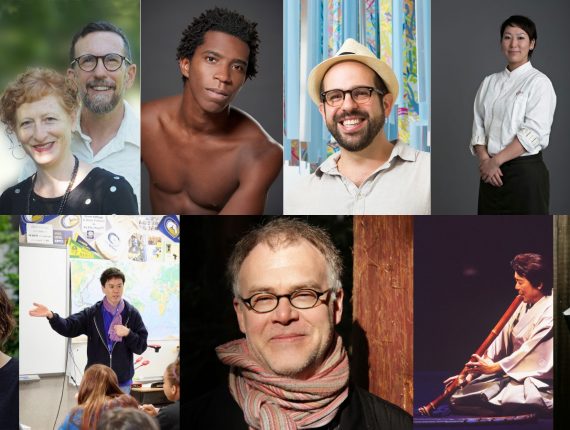
At a media reception at the U.S. Ambassador’s residence in Tokyo in February, announcing the artistic pairs, New York City dancer Cameron McKinney, founder of Kizuna Dance, performed with the principal dancer from renowned choreographer Toru Shimazaki’s company, with whom he is collaborating on this project. They plan a 10-dancer performance from both companies in Tokyo next summer. The original work will portray the bond of friendship that has developed between the two nations over the last several decades by accentuating the similarities – rather than the differences – between the two cultures.
“The work I do with Kizuna Dance is about sharing my love for Japanese culture,” Cameron says. “When I first heard about the JUSFC fellowship I thought it was the perfect way to promote cultural ambassadorship between our two countries, and to do that through my own artistic medium, rather than the more typical diplomatic route. It is such an exciting way to share a culture.” See a video of Cameron and his company rehearsing here.
The other three NichiBei Artists and projects include:
Ben Volta with Cho Kuwakado and Yasuyuki Sakura
Ben Volta, a Philadelphia creator of public murals and sculpture, and Japanese arts educators Cho Kuwakado and Yasuyuki Sakura, are engaging youth in the United States and Japan to create public art. The project draws inspiration from the accomplishments of distinguished Japanese and Americans in sports, science, and education. The completed collaborative artwork will express how art, innovation, and sport have the power to change the world. The artwork will be on display in Tokyo in summer 2021.
Gene Coleman with Adam Vidiksis, Sansuzu Tsuruzawa and Akikazu Nakamura
This innovative project combines Japanese martial arts, one of the earliest art forms, with music, video, motion-sensor technologies, and other digital media. Philadelphia-based composer, musician and director Gene Coleman and his partners will use digital technologies to translate martial arts movements into sounds, which will then form a landscape over which musicians will play. This work will be performed in Tokyo next summer.
Jesse Schlesinger with Masayo Funakoshi
This U.S.-Japan partnership between Jesse Schlesinger, a San Francisco-based artist, sculptor and designer and Masayo Funakoshi, chef-owner of Farmoon in Kyoto, will create an installation and performance-based work. The project explores sustainability through the lens of food and agriculture presented within an architectural installation serving as a temporary, experimental, and functional restaurant. This collaborative project will be available for viewing at the Setagaya Art Museum in summer 2021.
For a full description of the projects and artist bios, click here.
B-Roll of the artists’ projects is available, and they are available for remote interviews: For more information and to schedule, contact Karen Bate at 703.402.2672 or kbate@kbconcepts.com.
About the Japan-United States Friendship Commission: The Japan-U.S. Friendship Commission (JUSFC) is an independent U.S. federal agency. Its mission is to sustain the U.S.-Japan relationship by promoting Japan Studies, and collaborative institutional efforts, partnerships, and people-to-people exchanges that advance common interests between the United States and Japan.