

**U.S.-Japan Creative Artists Fellowship Program Grantees are available for interviews and demonstrations. B-roll is also available**
After the postponement of the 2020 Olympic and Paralympic Games for a full year, five teams of creative artists from the United States and Japan continued working together on innovative projects that reflected the themes of the Games; unity, collaboration and the long-time friendship between the United States and Japan. Some of these projects will finally be presented in Tokyo this summer/early fall with significant changes and updates to the original plans.
These teams of artists represent the 2020 U.S.-Japan Creative Artists Fellowship Program, funded by the Japan-U.S. Friendship Commission (JUSFC) and the National Endowment for the Arts (NEA) in partnership with the International House of Japan. Support for the program is also provided by the Arts Council Tokyo, Asahi Shimbun Foundation, United States-Japan Foundation, Government of Japan’s Agency for Cultural Affairs (Bunkacho), Setagaya City, and Setagaya Art Museum.
“Despite the challenges of the COVID-19 pandemic, these determined artists, with support from the Japan-U.S. Friendship Commission and the NEA, are wonderful proof of the value of cultural and artistic exchange between the U.S. and Japan, and the power of the arts to unite us and foster resilience,” said Paige Cottingham-Streater, JUSFC’s Executive Director in Washington, D.C.
The projects range across artistic disciplines, from music and dance to visual and culinary arts and sustainable agriculture. They explore subjects like martial arts (with karate being an Olympic sport for the first time at these Games), the recent 10th anniversary of the 2011 Fukushima disaster (known in Japan as 3-11), and sustainability through the lens of food and agriculture. This 2020 U.S.-Japan Creative Artists Fellowship Program is included in the prestigious Tokyo Tokyo Festival.The five teams of artists each received a $25,000 fellowship award and up to $2,500 for travel as part of their fellowship.
Journey Itself Home: Sue Mark & Bruce Douglas with Hiroyuki Abe & Natsuka Endo
When Conversation Artists Sue Mark and Bruce Douglas of marksearch left their Oakland, CA home for Tokyo in mid-March 2020 with their then 11-year-old son, they wondered if they were making the right choice. Having spent the entire pandemic in Tokyo since then, they made the most of their time there – amidst several lockdowns. With their Japanese partners Hiroyuki Abe and Natsuka Endo, and Kanagawa-based researcher and educator Honomi Ijima, the artists adjusted their presentation model to be as COVID-safe as possible.
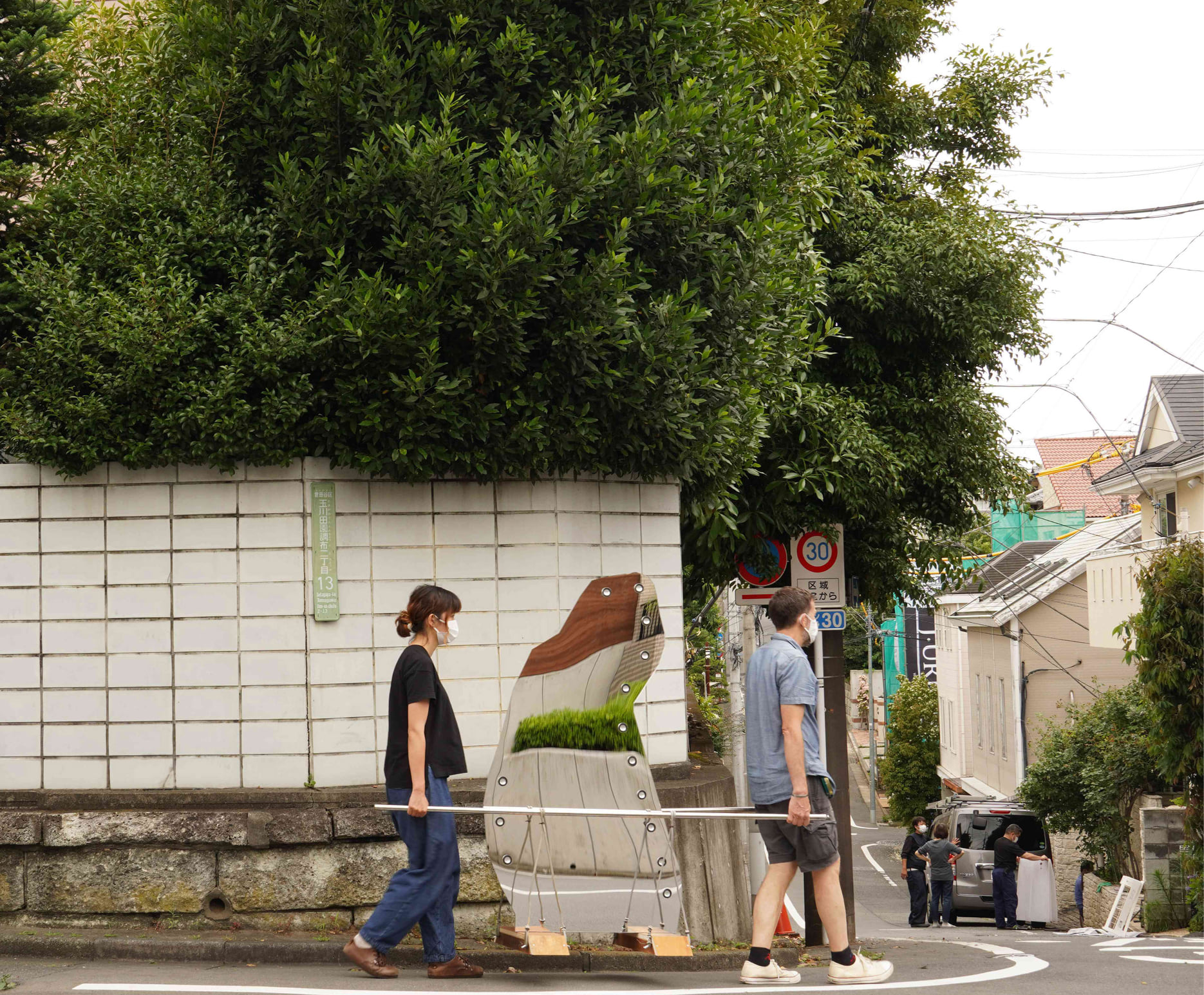
Journey Itself Home artists created mobile sound memorials from recorded Fukushima Disaster survivor stories. These ‘sonic haiku’ about adaptation, hope and the meaning of home form memorials modeled after Tohoku disaster monuments (seki hi),” Conversation Artist Sue Mark explains.
“To mark the 10-year anniversary of the Great East Japan Earthquake in March 2011, we embarked on Tabi Wa Sumika /Journey Itself Home, the creation of mobile sound memorials from recorded Fukushima Disaster survivor stories. These ‘sonic haiku’ about adaptation, hope and the meaning of home form memorials modeled after Tohoku disaster monuments (seki hi),” Sue Mark explains.
In recognition of the ongoing and challenging pandemic times, this interactive installation invites the public to share stories for their growing soundscape. Participants are encouraged to respond to these questions with sound, video, text or drawings:
What is on your mind right now?
What sounds bring you strength?
What sounds bring you a sense of safety?
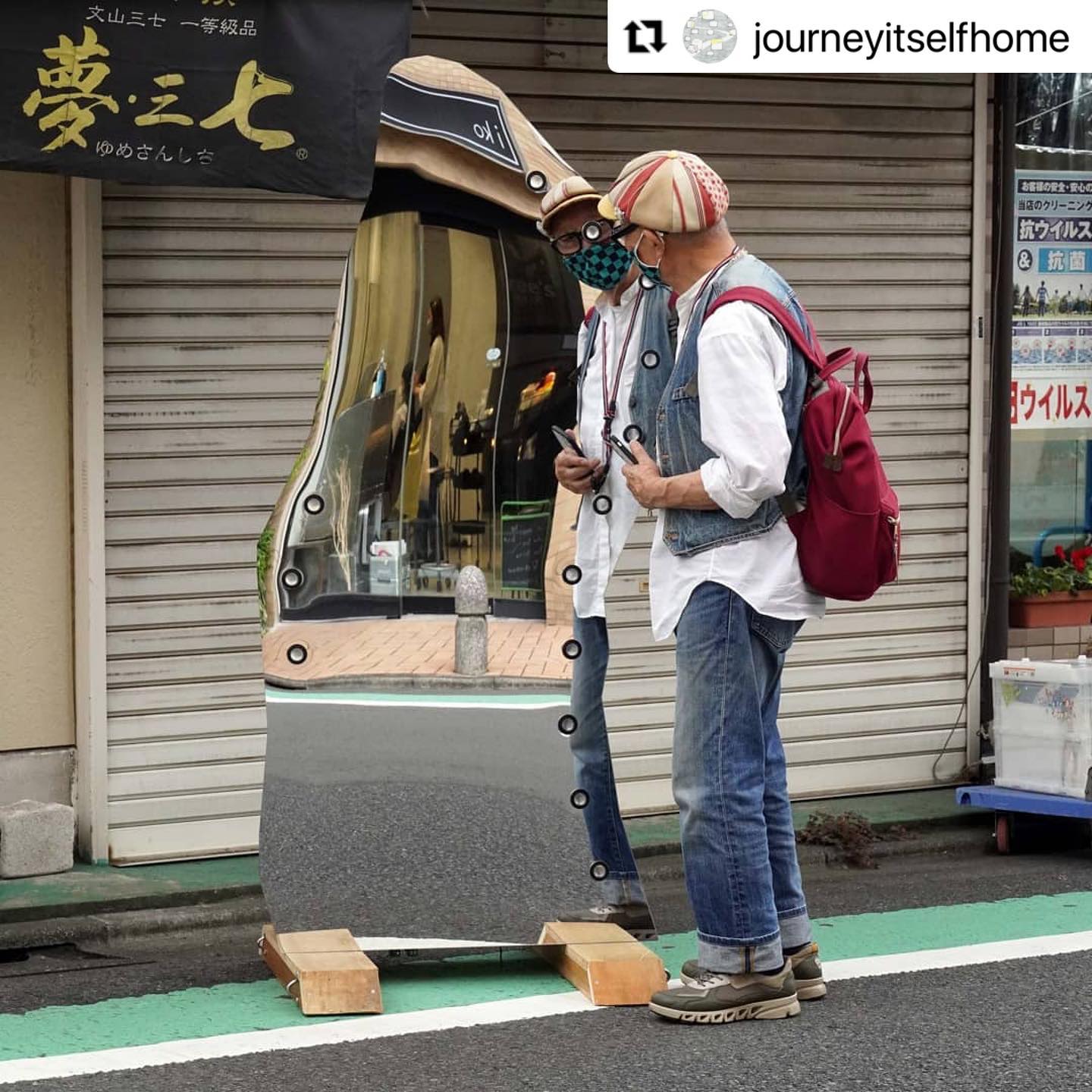
These sound memorials will be on display at the Setagaya Museum grounds July 27 until August 8, coinciding with the Olympic and Paralympic Games as part of the Japan-U.S. Friendship Commission’s Creative Artists Fellowship Program.
They installed the first mobile sound display at the Akasaka Hikawa Shrine on June 12, 2021. Others appeared at locations around Tokyo, and all will be shown at the Setagaya Museum grounds July 27 until August 8, coinciding with the Olympic and Paralympic Games.
“While the Olympics being delayed, being quarantined in a 400 square-foot apartment far from loved ones for over a year, and postponing our project could be seen as setbacks, we actually feel the meaning of our work is really amplified now,” Sue notes. “We see this work as a poetic act of radical caring. The Japanese concept of ‘shou ga nai’ (しょうがない)—which translates loosely to being at peace with that which is out of your control—is a very relevant theme, and one we tried to embrace over the last year,” she adds.
Ben Volta with Cho Kuwakado and Yasuyuki Sakura
In their first set of workshops with American and Japanese students in 2020, Philadelphia muralist Ben Volta and his Japanese partner Cho Kuwakado, along with collaborator Yasayuki Sakura of the Chara Rimpa Project (pronounced Kyara-Rimpa), focused on the intense energy needed to become an Olympic athlete.
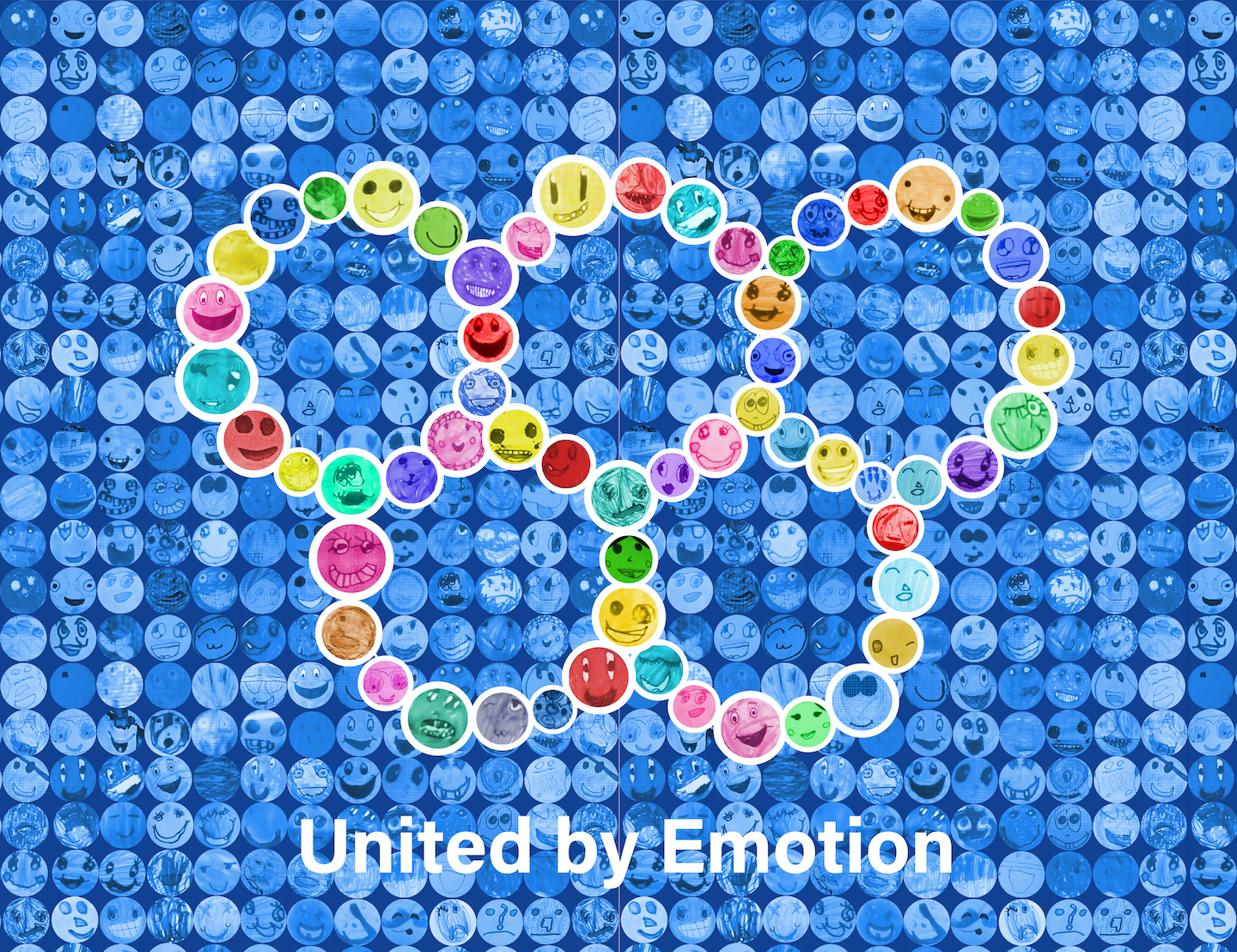
Japanese and American students learned about the Japanese artist Shigetaka Kurita, who created the first ever emoji characters in 1999. The students then drew their own emojis. The word emoji comes from “emotion” and the Japanese word for the letter “ji”.
“We asked the students to think about what their energy would look like if it was unleashed as a beautiful and creative line,” Volta recounts. “After some practice making energy line drawings, the students created rings or wreath designs using the lines, shapes and patterns they had drawn.”
Inspired by the Tokyo 2020 Olympics motto, “United by Emotion,” students also learned about the Japanese artist Shigetaka Kurita, who created the first ever emoji characters in 1999. The students then drew their own emojis. The word emoji comes from “emotion” and the Japanese word for the letter “ji”.
This Spring, Sakura designed a mosaic mural for a new Children’s Hall Kindergarten building in Saiki City in southern Japan, incorporating the student’s energy drawings. The team is also developing a temporary “United by Emotion” installation for the interior entrance of Bache Martin Elementary School in Philadelphia to celebrate students returning to school in the fall.
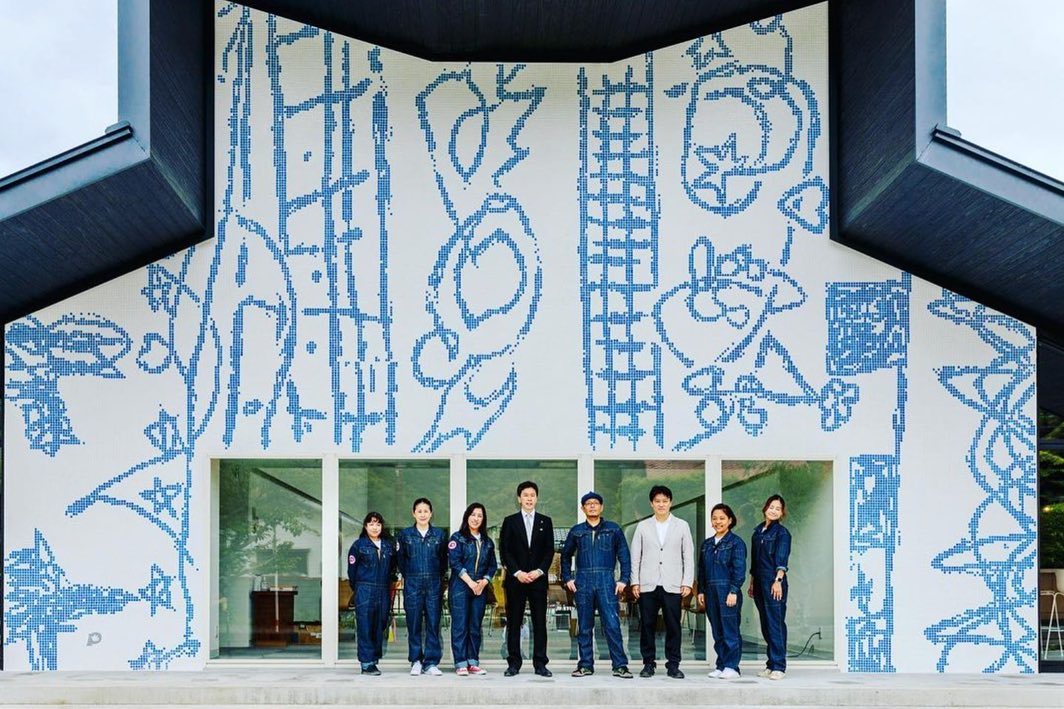
Muralist Ben Volta, his Japanese partners and students designed a mosaic mural for a new Children’s Hall Kindergarten building in Saiki City in southern Japan this Spring, incorporating the student’s drawings illustrating the energy required to be an Olympic athlete.
In August, “Cosmic Parasols” will be part of a pop-up installation displayed at the busy JR Oita Station in Oita, Japan August 23 – 28. The parasols will be wrapped with imagery exhibiting hundreds of energy drawings made by the American and Japanese students who participated in the workshops. The installation will also include a rocket sculpture designed by Sakura, containing a vat of indigo dye. The liquid will be used in workshops to create Shibori patterns on t-shirts and fabrics. The pop-up artwork will also host cosmic “treats” and STEAM artmaking workshops led by the Chara Rimpa team.
As the summer draws to an end the team will finalize the design for a culminating mural that will be displayed in Tokyo. This artwork will be on display in a soon to be announced location from the fall of 2021 – Spring 2022.
Gene Coleman with Adam Vidiksis, Sansuzu Tsuruzawa and Akikazu Nakamura
This innovative project combines Japanese martial arts, one of the earliest art forms, with music, video, motion-sensor technologies, and other digital media. Philadelphia-based composer, musician and director Gene Coleman and his partners will use digital technologies to translate martial arts movements into sounds, which will then form a landscape over which musicians will play. The project blends traditional shamisen and shakuhachi performances with cutting-edge technology. Adam Vidiksis has developed sensors and software that will capture biometric information from KATA performers, and will use that data as part of the overall work.
“The musicians are in different locations, so after multiple recording sessions, the music and video must all be mixed together to make the final work,” explains Coleman, the project’s artistic director. With Coleman currently unable to travel to Japan to work with his collaborative team, Nakamura and Tsuruzawa will visit Philadelphia August 7-15 to continue this artistic collaboration. Video of the production will be presented at a virtual event during the coming weeks of the Games.
Jesse Schlesinger with Masayo Funakoshi
This U.S.-Japan partnership between Jesse Schlesinger, a San Francisco-based artist, sculptor and designer and Masayo Funakoshi, chef-owner of Farmoon in Kyoto, explores sustainability through the lens of food and agriculture by creating a temporary, experimental restaurant. Unable to travel to Japan due to pandemic restrictions, Funakoshi will visit California August 8-14 to continue their collaboration.
“Masayo and I will work here in Northern California on the land where I have lived throughout the pandemic,” Schlesinger noted. “In the 16 months that I have been working here and growing food, I have reconnected with the landscape in a way that is perfectly copacetic with the originally stated goals of our JUSFC project. It seems fitting that she and I meet here.”
“August will be a bountiful time in the garden, and I anticipate a wide variety of crops will be ready for harvest during her visit.” Video of Schlesinger and Funakoshi’s time together will also be presented at a virtual event during the period of the Games. For this event, Schlesinger and Funakoshi are targeting August 31, which is Yasai no Hi, or the Day of the Vegetable, in Japan.
Cameron McKinney and Toru Shimazaki:
New York City dancer Cameron McKinney, and renowned Japanese choreographer Toru Shimazaki originally planned a live performance in Tokyo with dancers from both companies, now on hold. McKinney is the founder of Kizuna 絆 Dance, a New York City ensemble that celebrates Japanese language and culture through dance. Shimazaki is directing professor of dance at Kobe Jogakuin University in Japan, and founder of the Dance Barbizon company. For their collaborative project, the two are creating an original work of contemporary dance that features performers from both companies; it will portray Japan’s and the United States’ enduring friendship. The two companies have met and worked together online during the pandemic.
“The work I do with Kizuna Dance is about sharing my love for Japanese culture,” explains McKinney. “This project is the perfect way to promote cultural ambassadorship between our two countries, and to do that through my own artistic medium, rather than the more typical diplomatic route. It is such an exciting way to share a culture.”
For a full description of the original projects and artist bios, click here.
B-Roll of the artists’ projects, and the artists themselves, are available: For more information and to schedule, contact Karen Bate at 703.402.2672 or kbate@kbconcepts.com.
The Japan-U.S. Friendship Commission was established as an independent federal government agency by the United States Congress (P.L. 94-118) in 1975 to strengthen the U.S.-Japan relationship through educational, cultural, and intellectual exchange. The Commission is a grant-making agency that supports research, education, public affairs and exchange with Japan. Its mission is to support reciprocal people-to-people understanding, and promote partnerships that advance common interests between Japan and the United States.
More Information:
Karen Bate
kbate@kbconcepts.com 703.402.2672