

Before the inception of Collaborative Cataloging Japan (CCJ), video in the national archives of Japan remained largely focused on feature films.

CCJ curator’s talk with Julian Ross in June 2018. Photo by Rikumo.
“Experimental and avant-garde work and even home movies needed to be included in the archives,” explains CCJ Executive Director and JUSFC grantee Ann Adachi-Tasch. “Individual artists had been using their personal grant monies to archive their work one piece at a time. So, we created CCJ as a nonprofit to support these individuals.”
Established in 2015, the organization supports archiving Japanese film and video produced from the 1950s to the 1980s. After studying organizations in the U.S. that focused solely on video art, CCJ began to refine its prototype in building the necessary infrastructure to preserve these artistic legacies. Its primary functions are research and collection surveys to identify the video works and their condition in order to determine the urgency of immediate preservation for those facing deterioration. Additionally, artists are aging so CCJ conducts interviews to figure out the intention of these works as an important element of their research. They also find archive locations to physically house video art works.
Since 2016, JUSFC has funded critical exchanges between archivists from the U.S. and Japan as a part of CCJ’s Professional Exchange Program. CCJ invites archivists to travel abroad to expand their network and professional expertise through interactive workshops.“Film is fragile,” Adachi-Tasch explains. “And film preservation is complex and can be intimidating. It involves researching the details of each work. So, workshops allow people who care about preserving the movie image to share their skills and best practices.”
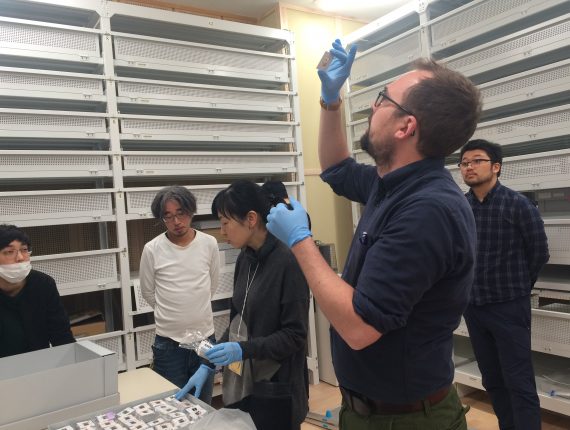
Collection Survey & Exchange Program in February 2018; MoMA archivist Peter Oleksis at Tokyo Photographic Art Museum. Photo by Ann Adachi-Tasch.
CCJ is using its most recent JUSFC grant to create materials for an exhibition of cinematic work as part of its Japanese Expanded Cinema Project. From film installations and performance art using light and film, they curate work that sits outside the traditional theater experience – works not meant to be watching while sitting.
CCJ also applies JUSFC funding to further its Digital Platform Project to create digitized film duplicates and a database of information collected from their surveys, such as artist bios, essays and excerpts of their work. The database currently includes 1,000 works, and ultimately will have both private and public access.
“Fundraising for this niche is incredibly difficult and JUSFC’s financial support is the most important we receive,” Adachi-Tasch shared. “It’s so encouraging that JUSFC recognizes the importance of what we are doing – it’s truly had an impact on the longevity of our organization.”
With growing interest in artist practices of the sixties, CCJ’s projects continue to expand into new projects. The organization plans to extend JUSFC funding to cultivate more partnerships with institutions that can make a difference in the life of the moving image in Japan.
Follow CCJ’s progress on social media: @CollabCatalogJapan on Facebook; @CollabJapanFilm on Twitter and Instagram. For more information on JUSFC’s Institutional Grant Program, visit https://www.jusfc.gov/grant_program/.