

For three weeks in June 2018, 13 students accompanied by two faculty members of Elizabethtown College participated in an interactive study abroad program in Japan. This two-credit course required students to write a daily travelogue of personal reflections of their experiences and insights into Japanese culture; complete assigned reading including a newspaper article and discussion of current events every day; participate in 16 field trips; and culminate their study with a white paper on a research project. This signature, proactive learning experience is the brainchild of Dr. Mahua Bhattacharya. As Director, she led the program’s design, coursework development, student selection and ground coordination of all activities. Accompanied by her husband, Dr. Jeffrey Long, a professor in the college’s religious studies department, she shared, “we’ve been doing this together for a long time and provide parental as well as academic support for our students.” Due to the rising costs of college tuition however, annual participation in the program has declined to an average of just 3-4 students in recent years. “Thanks to our grant from the Japan-U.S. Friendship Commission, I was able to offer a significant discount on the cost this year,” Dr. Battacharya pointed out. “As a result, we were thrilled to see a phenomenal rise in the numbers.”
With JUSFC’s support, interest in this year’s program multiplied by nearly five times the norm – with 18 student applications. The funding proposal covered 10 students,

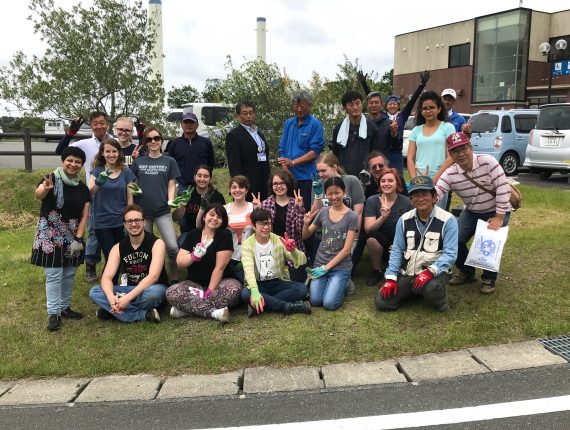
Elizabethtown students with their Ainu counterparts in Hokkaido.
and three additional students decided to take the course despite the higher cost. This prompted the college to provide supplemental funding to match the discount offered to the other 10 students.
With the additional funding, Dr. Bhattacharya was also able to integrate a new programming thread that included service learning and civic engagement, two values emphasized in Elizabethtown College’s overarching focus on peace, non-violence and social justice. Thus the 2018 exchange program, themed “Between Cool and 3:11 – Discovering Contemporary Japan Through Service Learning and Civic Engagement,” became a major draw and even greater success.
The students’ journey expanded to incorporate visits to Fukushima and Kesennuma where they engaged with the day-to-day lives of Japanese people affected by the unforgettable triple disasters that devastated Japan on March 11, 2011 – now known as 3:11. A 9.0 earthquake and subsequent massive tsunami off the Pacific coast of northeastern Japan left more than 18,000 dead or missing and displaced nearly 470,000 people. The tsunami destroyed infrastructure and triggered a nuclear explosion at the Fukushima Daiichi Nuclear Power Plant that disabled its power supply and cooling system, causing a level-7 meltdown. The subsequent high radioactive releases forced an emergency evacuation of nearly 100,000 residents. The program also included a visit to Sapporo, the capital of Hokkaido. There, in one of the largest cities in Japan, known for its cultural festivals, students engaged with members of the Ainu indigenous population of Japan and learned from a special cultural presentation featuring traditional garments, language, music and dance. “We truly appreciate JUSFC’s help in funding these new components of the trip. The entire experience was so much more meaningful and personal for the students as they engaged with the Japanese people and their culture,” Dr. Bhattacharya explained.
The service learning experiences involved two impactful site visits. In Hirono, a village in Fukushima affected by the nuclear disaster that is currently devising strategies to revitalize its local industry, students assisted by helping plant olive trees, a key element in the village’s economic development plan. Since olive trees absorb nutrients from the air rather than the soil, the radiation that seeped into the ground will not affect the olives produced. In Kesennuma, in Miyagi Prefecture, students listened to local youth affected by the tsunami share their experiences and discuss ideas to help revive their culture.“These two interactions engaged the local community in their process of healing themselves and let them know they are not
Elizabethtown Students and Dr. Bhattacharya with the Olive Tree they planted in Fukushima. The tree is named “Jay” after the Elizabethtown College mascot.
alone, that people in the United States do care about what happens to them,” Dr. Bhattacharya noted. “We sought to support their efforts, to provide an audience for them to talk about their situations, and to suffer alongside them in a meaningful way,” she added. Students also enjoyed a special visit and brief presentation by JUSFC’s Associate Executive Director. “The students spoke eloquently about JUSFC’s presentation, their overall experience and how they understood they are part of a global network that is relevant for every member of the Elizabethtown student community,” Dr. Bhattacharya said in summarizing the impact of the trip.
Inspired by the depth of her students’ impressive creative output following this first JUSFC grant – which took students throughout the northern region of Japan, known as “the public face” of Japan or Omote Japan – Dr. Bhattacharya submitted a proposal for, and was awarded a second grant proposal for next year’s program. The 2019 trip is designed for 15 students to travel to the country’s southern region, the “private face” or Ura Japan, where its villages are remote, rural and not as well traveled.
For more about Elizabethtown College and its Asian Studies program, visit the website here. To learn more about JUSFC’s Institutional Grant Program, visit www.jusfc.gov/grant_program.